
Hello again!
Last TS post, I reviewed the most common nutritional deficiencies that can affect thyroid function from the production level. Production of thyroid hormone is the first step (well, technically the second— the first step is the brain communicating with the thyroid). At any rate, we’re still covering thyroid hormone PRODUCTION issues.
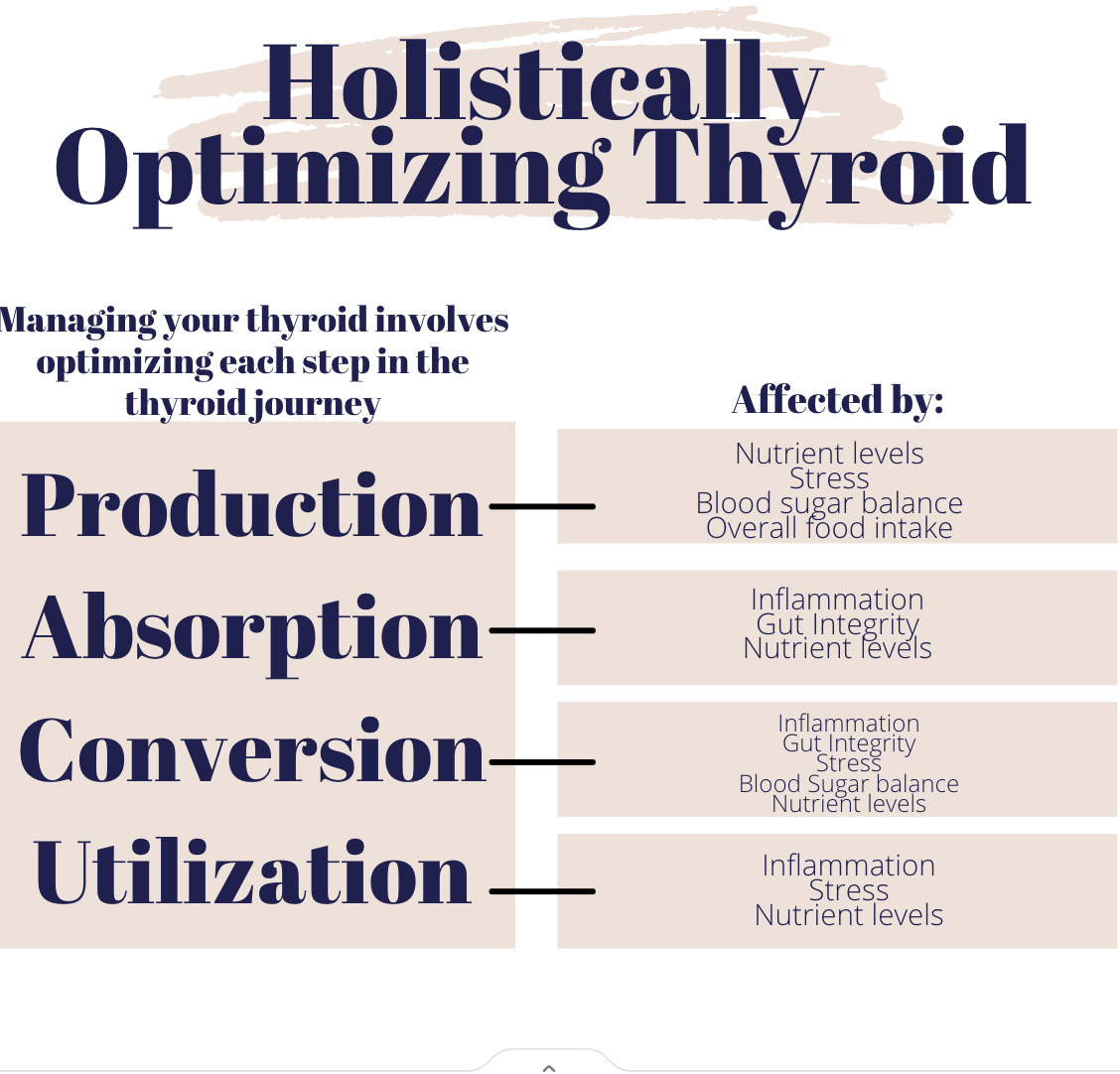
There’s a lot of ground to cover for thyroid hormone production, but before I move on, I wanted to dive deeper into nutrient deficiencies. First, why do deficiencies happen, how to determine if you have any, and what to do about it?
First, what is“nutrient deficiency”? This is specific to MICRO-nutrients and not MACRO-nutrients. Micro-nutrients are needed in much smaller amounts in the body— think micrograms. Macro-nutrients are needed in much larger amounts— thing grams, ounces, and more.
Micro-nutrients: vitamins, minerals, amino acids, fatty acids, metabolites
Macro-nutrients: carbohydrates, fats, proteins
Micronutrients are very important, what’s more important is to optimize your macronutrient intake FIRST (carbs, proteins, fat) as those are priority and serve as a delivery system for micronutrients. This is why you can’t just take vitamin supplements and stay alive. Humans MUST eat in order to survive!
Psst…macronutrient balance is a foundation piece to all of the nutrition work I do with 1:1 and group coaching clients as part of my proven and effective The BRAIN Method — my five step nutritional therapy framework that teaches you the most impactful fundamental nutrition skills to feel and function at your best!
The body is dynamic— to say the least! It functions by creating several chemical reactions that are fueled by the nutrients, fluids, electrolytes, etc. that we get from food, water, sun, and even some that we produce on our own. Just take a peak at metabolism:

Yikes! Did I scare you yet?!
After seeing how much nutrition impacts every single cell in the body, it is understandable that with changes in demand, internal structure, and other factors, the nutrient status isn’t as clean-cut as eating 1000mg of a nutrient, absorbing all 1000mg, and utilizing all 1000mg. There’s a lot that goes on between Point A and Point B.
Reason #1 for Micronutrient Deficiency
Supply VS Demand
Demand is the need for nutrients that can increase or decrease depending on several factors. We all have a baseline demand for micronutrients. With increases in demand, it is important that the supply we provide through the diet is ample to meet it.
Demand for nutrients increases during times of: high stress, inflammation, healing, pregnancy/postpartum, exercise, poor sleep, growth
Factors that affect supply of nutrients: poor soil quality, poor food quality, inadequate intake overall, elimination of macronutrient group (i.e. low fat diets, vegan diets, keto diets)
Reason #2 for Micronutrient deficiency:
Absorption
Absorption of micronutrients depends on a fully functioning digestive tract, including physiological structure as well as enzymes/acid produced along the digestive journey. A proper diet and supplementation is all for naught if we are unable to absorb the nutrition we are consuming. Our ability to absorb nutrients from food and supplementation is affected by several factors, which include prescription medications, inflammation in the gastrointestinal tract, suboptimal digestive enzyme production, stress, aging, alcohol consumption, excessive caffeine intake, and exercise.
Reason #3 for Micronutrient Deficiency
Improper Utilization
Utilization: Due to genetic variances, each one of our ability to utilize certain nutrients is different. Single Nucleotide Polymorphisms (SNPs) are inherited genetic variations. In order for our body to make new cells, it copies genetic sequences and replicates them over and over. If one of these sequences is out of order, missing a piece, it results in abnormalities to the way the body functions. One of the most common mutations it the MTHFR mutation.
The best way to identify nutrient deficiencies?
TEST, don’t guess!
The most well-intentioned, well-done, and well-known food tracking apps do not account for your unique physiological situation. You may be in a season of higher demand, or perhaps be on medication that hinders absorption, or even have a genetic mutation that requires you to have more of a certain vitamin.
There are a few ways to test for micronutrients including blood, urine, and hair testing. Each have their own pros and cons, and while there is no one right way, blood testing tends to be the most utilized in clinical research and more likely to be ordered by your doctor.
As part of my 1:1, I order a micronutrient panel on EVERY SINGLE PERSON. It is THAT important! Nutrient deficiencies are like having a car that is long overdue for an oil change and gas. You may get to your destination, you may not.
Oh, this is important! Included in this email is a handy sheet you can use to request nutrient levels. Please remember that while several nutrient labs are listed, they’re not always part of a standard panel nor commonly ordered. As a Dietitian, it is my job to assess nutrient status, so naturally, it’s at the forefront of my brain. If your provider is unfamiliar, please be kind! Their job is not to know all about nutrition like it is mine. Additionally, it is also helpful to work with a professional like a Dietitian who knows how to interpret nutrient status labs and suggest safe supplementation to your unique situation! Your health requires a team effort— we all have our zone of genius! 🙂
Catch up on Thyroid School:
Issue 2// Thyroid Hormone Production
Issue 3// Root Causes of Hypothyroidism, Part 1
Issue 4// Root Causes Of Hypothyroid, Part 2: Nutrient Deficiency
Issue 5// Root Causes of Hypothyroid, Part.2, Nutrient Deficiency, Continued.
Disclaimer: Please note that “Thyroid School” emails from Chews Food Wisely, LLC (and Nicole Fennell, RD) are not intended to create any physician-patient relationship or supplant any in-person medical consultation or examination. Always seek the advice of a trained health professional with any questions you may have regarding a medical condition and before seeking any treatment. Proper medical attention should always be sought for specific ailments. Never disregard professional medical advice or delay in seeking medical treatment due to information obtained in “Thyroid School” emails. Any information received from these emails is not intended to diagnose, treat, or cure. These emails, websites, and social media accounts are for information purposes only. The information in these emails, websites, and social media accounts are not intended to replace proper medical care.


EMAIL:
hello@chewsfoodwisely.com
VIRTUAL APPOINTMENTS ONLY
Business Mailing Address:
2525 Robinhood Street
Houston, Texas 77005
© 2026 Chews Food Wisely. All Rights Reserved. Website Designed by AVM
Disclaimers | Privacy Policy | Terms of Purchase | Terms and Conditions