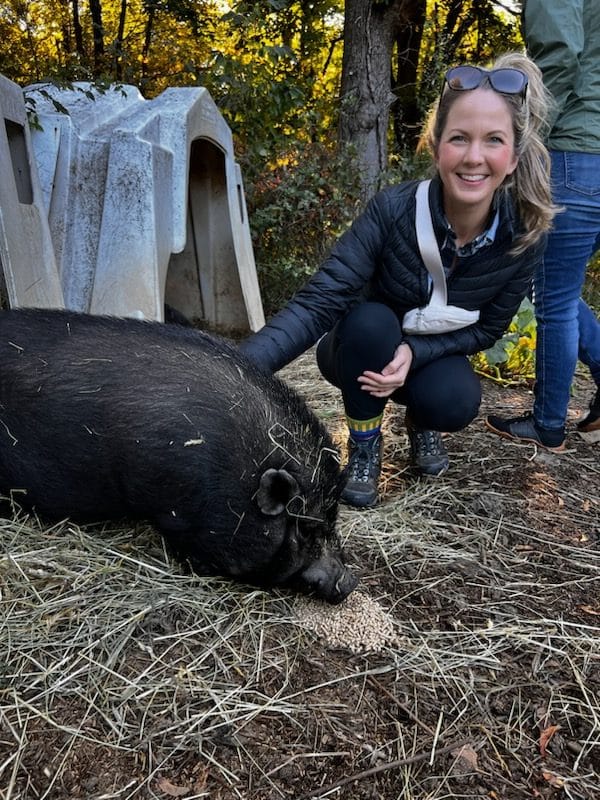
I went to Farm Camp in the hills of Maryland a few weeks ago. (Scroll all the way down to see pictures!) As a city gal to the core, the novelty of seeing pigs and petting goats and gathering chicken eggs seemed like a fun time, but I took away more than just cute photos for the ‘Gram. Humbling ourselves and learning from the animals and the ecosystem taught me valuable lessons and highlighted weak spots in my own personal healing journey.
In healthcare, and even in the functional medicine space, there can be an over-emphasis on protocols and supplementation/medication and lab testing/diagnostics, but not enough attention paid to the fundamentals of health.
There are essential elements we need to achieve our highest selves (called self-actualization). According to Maslow’s hierarchy of needs, these are listed in order:
Physiological (food, shelter, water)
Personal Safety (structure, order, resources, security)
My interpretation of this pyramid is that without feeling safe and secure, physically and emotionally, it’s nearly impossible to achieve your highest potential. Food is at the base of this pyramid. Nourishment is a requirement.
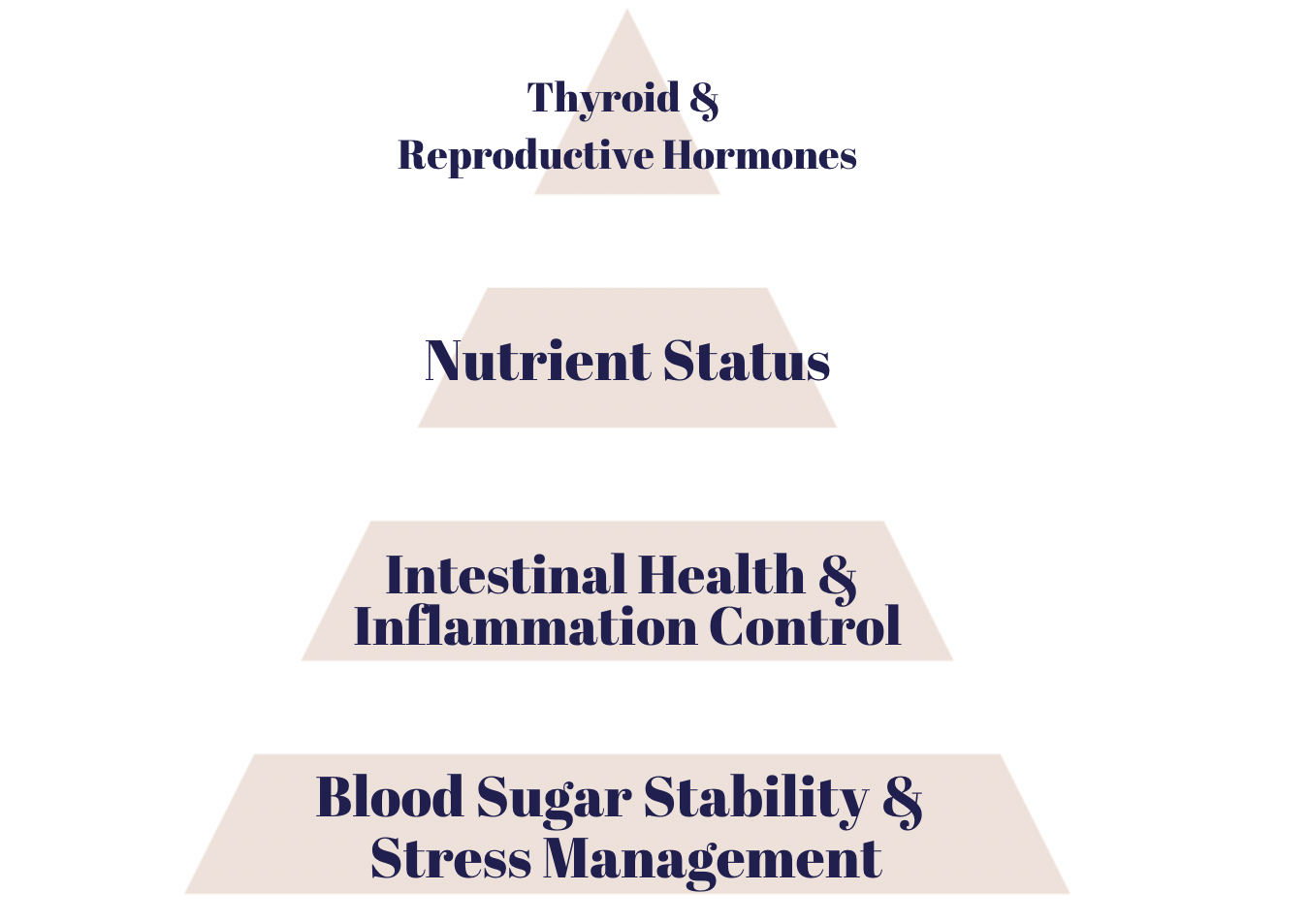
Similarly, in my practice of nutritional therapy, there are fundamental steps to achieving optimal health. Supplements and lab testing are helpful, but only after the foundational pieces are set in place and practiced consistently. When it comes to hormonal dysregulation, like thyroid hormone dysregulation, my unique fundamental approaches are as follows:
One of the primary functions of the brain is to keep us alive. Our brains are constantly scanning the environment for stressors— both physical and emotional threats to our safety. Sometimes, we don’t even realize the stressors our brain may be picking up on.
Food is one of the foundational ways that the brain feels safe. Without this sense of safety, the primitive survival brain takes over to sound the alarm bells to the rest of the body. When the brain triggers the stress response, or flight/flight/freeze, other functions like rest/digest/reproduce/metabolize slow down.
Think of it this way: if you were to lose your job today, would you go out and buy a brand new Ferrari or would you cut back on spending and save your money? There isn’t a right or wrong choice (it’s your money!), but there’s definitely a safer choice.
In the face of perceived insecurity, the body begins to conserve energy. What might this look like and feel like?
Tanked energy during the day
Stubborn weight loss resistance or unintentional weight gain
Poor focus and attention
No libido
Low body temperature
Period irregularity
Thyroid dysfunction (which is a metabolic adaptation). During times of higher stress, the brain will produce less TSH (thyroid stimulating hormone), which means that the thyroid produces fewer hormones and you become hypothyroid! If you have low TSH and low thyroid hormones, this is a big sign that your body is under stress! Normally, TSH will elevate in response to low circulating levels of thyroid hormones. Stress hormones can have an immune system dysregulating side effect, making autoimmune thyroid issues largely rooted in an over-active stress response!
Sluggish digestion (leading to bloating, gas, and “IBS” type symptoms)
Less motivation to do things
Irregular heartbeat
Cravings and hyper-fixation on food. (Sometimes people will transition into having no appetite after being in “conserve” mode for so long. Waking up and not hungry for hours? That’s a tell-tale sign!)
Decreased recovery from illness and exercise
… and more!
Experiencing life on the farm forced us into slowness and stillness— more so than most of us were used to. Things don’t happen quickly in nature, and maybe that’s the way it’s supposed to be. Maybe the hustle is what is hindering the healing process.
So what if in addition to the labs and supplements and protocols we all made more of an effort to:
Move at the pace of nature. We’re not meant to be go-go-go all the time. That in and of itself is a stressor to the body. Margin in your day is not a luxury, but a necessity.
Accept that slow, steady progress is still progress. I’m in the process of making gluten free sourdough, and it’s taking DAYS! While this is secretly killing me inside (LOL), it’s also such a lesson in patience. I find that the only way to grow my patience is to do things that require me to be patient.
Ask yourself, “How does this feel” (not just physically, but also emotionally). Making choices that are in alignment with your values and beliefs helps the choices stick. So many times our host, Alison, would encourage us to not get too hung up on exact measurements in recipes and otherwise ask us, “How does it feel?” or “What do you think seems right?”. It made me realize how often we just do things because we’re instructed and don’t always check in to see how it actually feels. You’re in charge of your body. Is how you’re eating now actually making you feel good?
Find ways to be more connected with food. Maybe this means supporting your local farmer, shopping at smaller grocery stores, starting an herb garden, and/or getting into the kitchen a few times per week and making a meal. Maybe instead of viewing food and cooking as a distraction from our work, let making nourishing meals be amongst your most important work.
Get your hands into the dirt and away from your keyboard more often. Getting outside in nature exposes us to so many beneficial microbes and energetically recharges us. The production of many hormones begins with sunshine getting into our eyes and skin. Our skin and nasal passages absorb microbes (bacteria, yeast) in the air and dirt that boosts our immune system. Maybe you’re not ready for dirt, but can you get your hands onto some food? As we were weaving the topping to our apple pies, my friend Christa said, “Wow, I think this is the most relaxed I’ve ever seen you”. Working with your hands can be so calming!
Simplify food. Sure, food CAN seem complicated, but it doesn’t have to be. Assess your meals and ask yourself: does this meal have protein, carbs, fat, and veggie? If you have those, you’ve hit the basic building-blocks for a solid, balanced meal.
Rest is a requirement, not a recommendation. Animals sure do sleep…a lot. Like, a lot, a lot. When did we start to wear our lack of sleep and over-committed schedule as a badge of honor? Not sure about you, but I haven’t received a prize or a parade for burning the candle at both ends.
When I’m working with clients, we focus on a ground-up approach to nutrition to make sure that we don’t miss steps in building a solid nutritional foundation. We work together to establish a repeatable and sustainable formula to simplify the act of eating:
Meal Timing: Establishing an eating routine that fits their schedule.
MACRO-nutrient balance
Presence: Identify the presence of the essential food groups on the plate.
Proportion: Have a sustainable framework to follow to properly balance the food groups on your plate.
Portion size: Then audit the portion size (this is optional). Just like with any auditing process, this isn’t done ALL the time. It’s just a check in tool.
MICRO-nutrient repletion
Once we establish the foundation, we focus on repleting micro-nutrients through nutrient dense foods, therapeutic foods, and targeted supplementation (as needed). This is where labs and protocols can be helpful, but only after the essentials are covered. Testing, not guessing, when it comes to therapeutics.
Do you need support in turning these nutritional ideals into reality?
I'm Nicole, Integrative & Functional Registered Dietitian Nutritionist — and a Hashimoto's patient and busy momma of three who has been in your shoes. I spent years trying to figure out why I felt so off despite doing all the "right" things, and that experience completely shaped the way I work with women today.
My whole approach is built around nourishing your body with real food you actually want to eat, not white-knuckling your way through a six-week protocol that leaves you more exhausted and more confused than when you started. Because restriction doesn't heal anything. Real, sustainable nourishment does.
I'm a college professor and educator at heart— I teach a range of classes from freshman level "Introduction to Nutrition" and graduate-level Women's Health and Nutrition courses, and that passion for making complex science click in plain English is woven into everything I do. If you leave a session without actually understanding why we're doing what we're doing, we haven't done our job.
I love going on long walks while listening to an audiobook (my FAVORITE is The Count of Monte Cristo, but I'm currently reading Lord of the Rings), being totally outnumbered with my three wild kiddos, eating yummy food, sipping a good cup of coffee, and (trying) to crochet!
Freebies For you!
Kickstart your journey without feeling overwhelmed! Check out our free resources for women living with thyroid issues, Hashimoto's, PCOS, insulin resistance, weight loss resistance, and exhaustion.
Whether you're running on fumes no matter how much you sleep, trying to make sense of a Hashimoto's or thyroid diagnosis, dealing with periods that knock you completely sideways, navigating PCOS, struggling with cholesterol or blood sugar that won't cooperate, or carrying weight that refuses to budge no matter what you try — please know you are not alone. And more importantly, there is an actual reason you feel this way. At Chews Food Wisely, we're not here to hand you a meal plan and wish you luck. We're here to look at your full picture — your labs, your symptoms, your life — and find the connections that explain why your body has been doing what it's been doing. Then we build you back up with real food, realistic strategies, and a plan that fits your actual life. Not a protocol designed for someone else's body.