
This topic is a bit heavy, however, I want to introduce it as a means to educate you that if you’re still dealing with hypothyroid symptoms and your labs look “normal”, it may not be all in your head.
Cellular hypothyroidism occurs when the free and available thyroid hormones do not cross the cell membrane into the cell where their metabolic activity occurs. This is coined as “cellular” hypothyroidism because it is not related to overall production , but rather a disconnect in getting the thyroid hormone to the right place.
Cellular hypothyroidism can be a bit difficult to identify on lab tests because it’s not always straight forward. Labs primarily look at serum values, which are normally very useful! However, in the case of cellular hypothyroidism, the serum values can reflect optimal values extra-cellularly, but in reality the cells are deficient intra-cellularly.
A meta-analysis shared that “serum thyroid levels are, of course, commonly used as an indication of tissue thyroid activity. However, in order to have biological activity, T4 and T3 must cross the cellular membrane from the serum into the target cells. It follows that the activity of these transport processes may have a significant influence on the regulation of biological activity of these hormones.”
What contributes to cellular hypothyroidism?
Low calorie dieting
Insulin resistance
Inflammation
Type 2 Diabetes
Advancing age
Mitochondrial dysfunction
Chronic stress
Infections
Nutrient deficiencies
Research has identified a few reasons why labs may not reflect this phenomenon which includes:
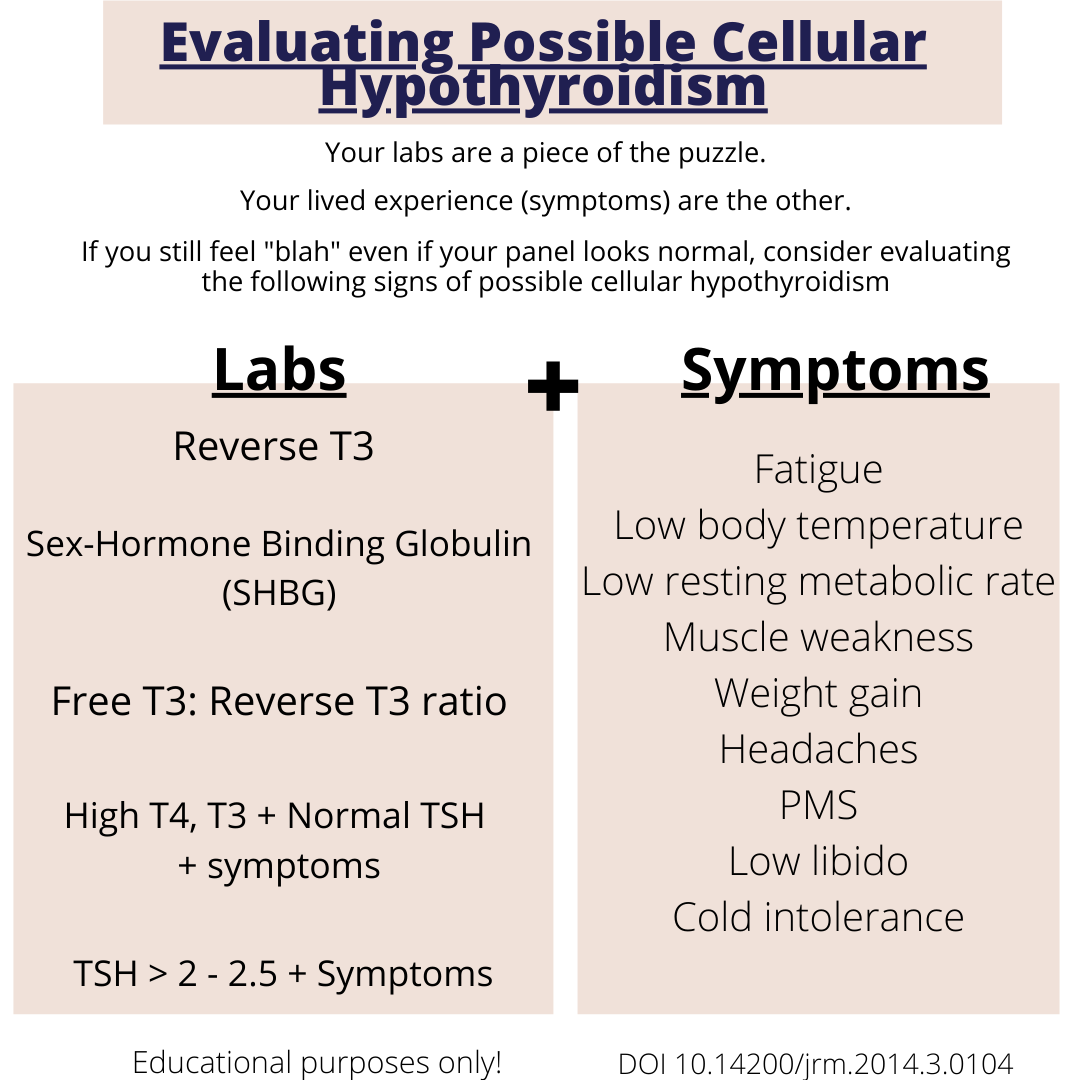
1. The pituitary gland (that produces Thyroid Stimulating Hormone- TSH) has different thyroid receptors and transport mechanisms than tissue cells. One of the most dramatic differences is that the pituitary receptors use passive diffusion which means it does not require energy whereas the tissue cell receptors rely on active transport (needs energy). Because of this, the pituitary may not be as responsive to changes in energy intake and utilization from dieting, insulin resistance, etc. and therefore not reflect hypothyroidism as rapidly as the tissue cells would. While dieting, as a means to preserve energy during low calorie intake, the cells can resist uptake of thyroid and lead to higher levels of hormone in the serum— which means labs may show high T4 and T3 as they stay in the serum instead of crossing the membrane into the cell.
2. Stress affects the pituitary thyroid receptors and tissue cell receptors differently. Chronic emotional or physiologic stress can cause a significant reduction of transport of T4 into the cells of the body. In some cases, serum T4 levels can be artificially elevated among physiologically stressed individuals. Substances produced by physiologic stress or calorie reduction have been shown to reduce the cellular uptake of T4 by up to 42%, while having no effect on T4 or T3 uptake into the pituitary.
How to evaluate whether you may be dealing with cellular hypothyroidism? Compare your labs with your symptoms. Below is a helpful graphic, but it’s always wise to work with a pro to discuss your individual case.
What can you do about it?
Make sure you’re eating enough.
Manage stress.
Check vitamin & mineral status.
Don’t be afraid to salt your food.
Focus on nutrient-dense foods.
Optimize sleep.
Share symptoms w/ your provider.
Discuss whether T4 or T4 + T3 replacement is best for you.
Don’t try to DIY. Work with a pro.
Have a great one!
Nicole
Disclaimer: Please note that “Thyroid School” emails from Chews Food Wisely, LLC (and Nicole Fennell, RD) are not intended to create any physician-patient relationship or supplant any in-person medical consultation or examination. Always seek the advice of a trained health professional about any questions you may have regarding a medical condition and before seeking any treatment. Proper medical attention should always be sought for specific ailments. Never disregard professional medical advice or delay in seeking medical treatment due to information obtained in “Thyroid School” emails. Any information received from these emails is not intended to diagnose, treat, or cure. These emails, websites, and social media accounts are for information purposes only. The information in these emails, websites, and social media accounts is not intended to replace proper medical care.


EMAIL:
hello@chewsfoodwisely.com
VIRTUAL APPOINTMENTS ONLY
Business Mailing Address:
2525 Robinhood Street
Houston, Texas 77005
© 2026 Chews Food Wisely. All Rights Reserved. Website Designed by AVM
Disclaimers | Privacy Policy | Terms of Purchase | Terms and Conditions